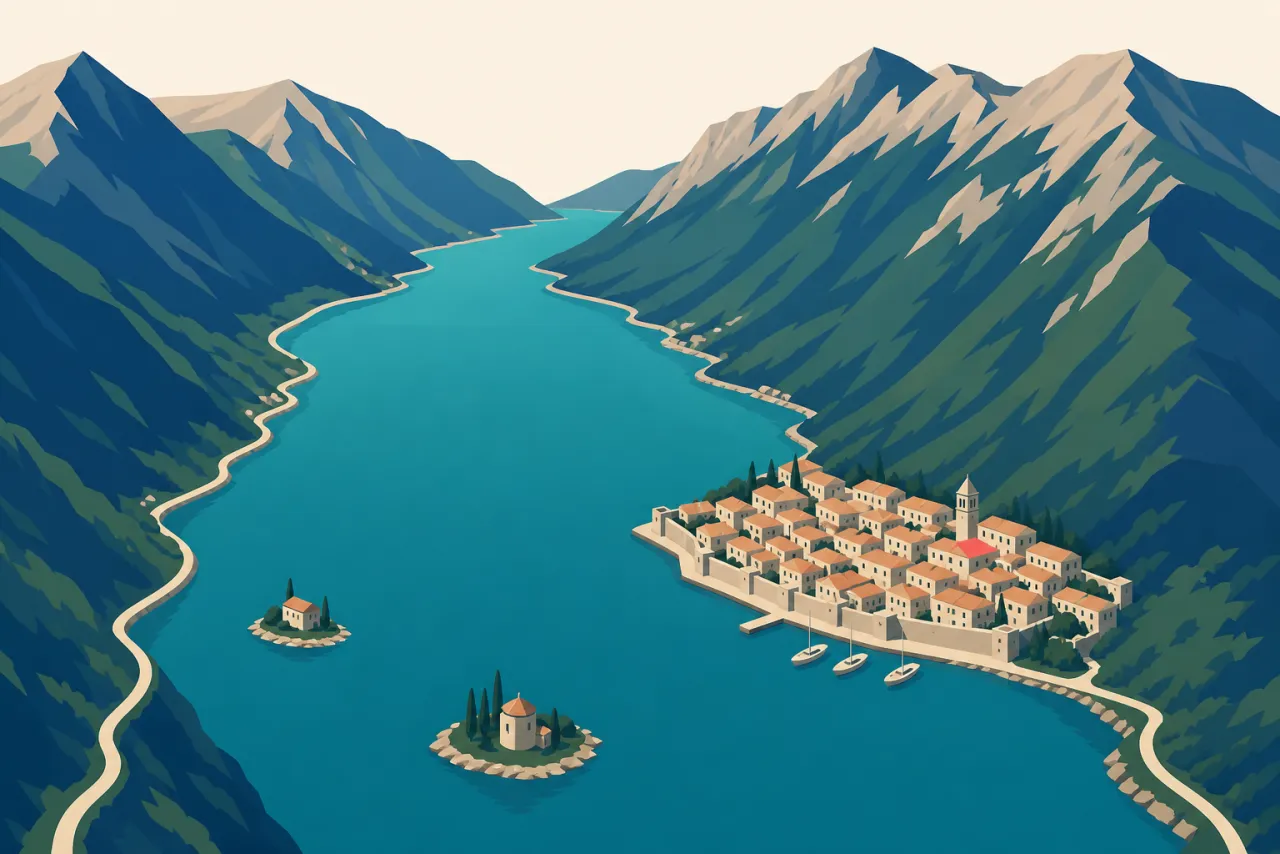
Montenegro sits 55th out of 217 in our world ranking, with a FiScore of 6.9 out of 10. It has one of the lightest tax systems in Europe, on an Adriatic coast that looks like Croatia twenty years ago, at a cost of living that is nothing like it.
The country is a candidate for European Union membership, which is at once its main asset and its main risk.
The rates
| Tax | Rate |
|---|---|
| Personal income | 0% to 15% |
| Companies | 9% to 15%, by band |
| VAT | 21% |
The personal scale starts at zero and tops out at 15%.
Corporate tax runs in bands: 9% on profit up to EUR 100,000, 12% from EUR 100,000 to EUR 1,500,000, and 15% above that. For most arrivals only the first band matters, and 9% is among the lowest rates in Europe.
What actually attracts people
Cost. Setting up and running a Montenegrin company costs a fraction of the equivalent in Western Europe. Salaries, rent and professional services follow the same scale.
The euro without the euro area. Montenegro adopted the euro unilaterally in 2002. You invoice and live in euros with no exchange risk against European clients, while sitting outside the monetary union entirely.
Residence is reachable. Forming a company locally opens a route to a residence permit, on conditions far lighter than inside the Union.
The setting. The Bay of Kotor, a mountainous interior, and a coast that stays affordable out of season.
If you are British, the main drawback costs you less
This is where a British reader's position differs from a French one's, and it changes the comparison.
For an EU national, leaving the Union for Montenegro means giving up free movement, freedom to provide services and the directives that go with them. That is a real loss, and it is why a French reader is usually pointed to Bulgaria instead.
A British reader has already paid that price. Outside the Union since Brexit, they need a permit for Bulgaria as much as for Montenegro, and the freedom to provide services they would be giving up is not theirs to give. Against Bulgaria's 10%, Montenegro's 9% and much lower running costs stop looking like the weaker option.
The comparison is genuinely closer for a Briton than the French version of this page suggests.
The drawbacks, and they count
The country is not in the European Union. No freedom to provide services, no European directives, and a Montenegrin invoice that goes down less well with a German client than a Bulgarian one at a comparable rate.
Accession is a two-edged bet. If Montenegro joins, it gains the single market and probably loses part of its tax advantage to harmonisation pressure. The timetable has been announced and pushed back more than once, and we do not date it here.
The administration and the banking system are young. Opening an account takes time, and English is not systematic at the counter.
The economy is small and concentrated on tourism and property, which makes it sensitive to shocks.
Substance matters here as everywhere. A Montenegrin company run from London is a British company as far as HMRC is concerned.
So, who is Montenegro for?
- An entrepreneur wanting a very low structure cost: 9% on companies and minimal running costs, hard to beat in Europe.
- Someone selling outside the European Union: non-membership costs you nothing.
- Someone selling a lot of services into the EU: this is the weak point. Look at Bulgaria, which offers 10% inside the single market.
- A property investor with a long horizon: the accession bet plays out here too.
The full table of Montenegrin rates is on our Montenegro page, and the comparison tool puts it next to anywhere else. Before deciding anything, read how to actually leave.
Sources
The Montenegrin tax administration and PwC Tax Summaries, verified in August 2026. Corporate bands from our own country pages. An error reported to us gets fixed.
This page informs, it does not advise. Before deciding anything, talk to a professional who will look at your situation, as our terms of use set out.